

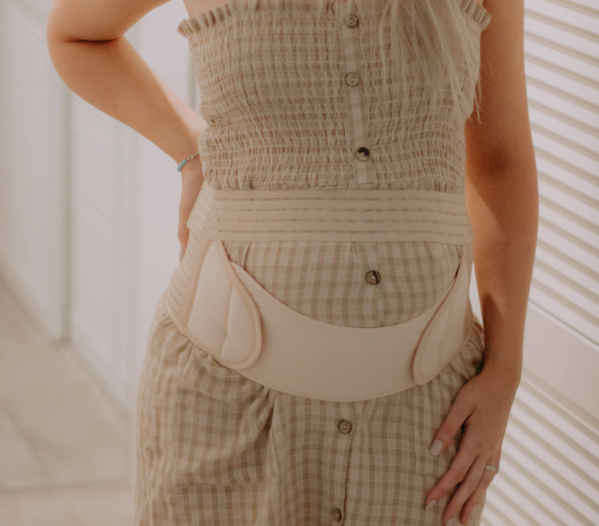
There is a moment in mid-pregnancy when the body stops feeling manageable. The bump is not yet enormous, but getting up from a chair has become an event, rolling over in bed takes planning, and the lower back aches in a way that sleep does not fix. Most women attribute this to the weight of the baby. The weight is part of it, but the more interesting culprit is a hormone that began its work weeks earlier without announcing itself. Understanding this changes how a prenatal belly bandis used — and more importantly, when.
Relaxin Works Before the Bump Arrives
Relaxin is released from early in pregnancy to gradually soften the pelvic ligaments ahead of labour. The problem is that it does not wait for the third trimester to start causing instability. The sacroiliac joints — where the pelvis meets the base of the spine — begin losing their usual rigidity whilst the bump is still relatively small. This is why pelvic girdle pain often feels disproportionate to the visible size of the pregnancy. The joint instability is real and measurable well before the weight loading becomes severe. Women who understand this stop blaming themselves for being unfit and start addressing the actual structural issue.
The Pelvic Floor Is Already Stretched
Here is what rarely gets mentioned alongside belly band advice: the pelvic floor does not just suffer during labour. It is under continuous load from the moment the uterus begins to expand, and that load increases every week. A prenatal belly band that lifts the bump upward and forward does something the pelvic floor cannot do for itself — it reduces the downward pressure that has been building for months. This matters beyond comfort. Pelvic floor dysfunction after pregnancy is strongly associated with the cumulative load it carries during pregnancy, not just the delivery itself. Supporting the bump earlier rather than later is one of the few practical ways to reduce that accumulation.
Wearing It Earlier Changes the Outcome
The most common pattern is to put on a belly band once the pain is already established. It helps in that context, but it is working against fatigue that has already set in. Pelvic instability compounds across a day of activity — each hour of standing or walking loads the sacroiliac joints incrementally, and the muscles surrounding them start compensating well before any conscious aching begins. Putting on a prenatal belly band at the start of a long day, before the compensation pattern has started, means the joints are supported through the loading rather than rescued afterwards. Women who shift to this approach consistently describe the difference as significant.
Why It Stops Working and What to Do
A band that felt genuinely helpful for several weeks can suddenly seem pointless. The band has not changed — the body’s geometry has. When the baby engages in the final weeks of pregnancy, the bump drops and the weight distribution shifts anteriorly in a way that renders the previous wearing position ineffective. The band needs to follow the bump downward and tilt slightly more forward to continue providing lift. Most women do not know to make this adjustment and conclude the product has stopped working. A pelvic health physiotherapist can reassess the fit in under ten minutes and restore most of the support that seemed to have disappeared.
Posture After the Band Comes Off
Regular use of belly support during pregnancy has a less obvious secondary effect: it gives the body repeated exposure to neutral pelvic alignment at a time when anterior pelvic tilt would otherwise become habitual. Muscles adapt to the positions they are held in most frequently. Women who wear proper support through active periods of pregnancy tend to carry themselves differently after birth — less entrenched in the compensatory posture that pregnancy encourages, and faster to recover functional strength in the deep stabilising muscles. It is a modest effect, but it is real, and it is not something that gets included on the packaging.
Conclusion
A prenatal belly band works best when it is treated as a structural intervention rather than a comfort product. It reduces pelvic floor load during a period when that load is cumulative and consequential, supports unstable joints before compensation patterns become habitual, and — when adjusted correctly as the body changes — continues to provide meaningful support through to the final weeks. The women who use it well are the ones who understood what it was actually doing beneath the surface.
