

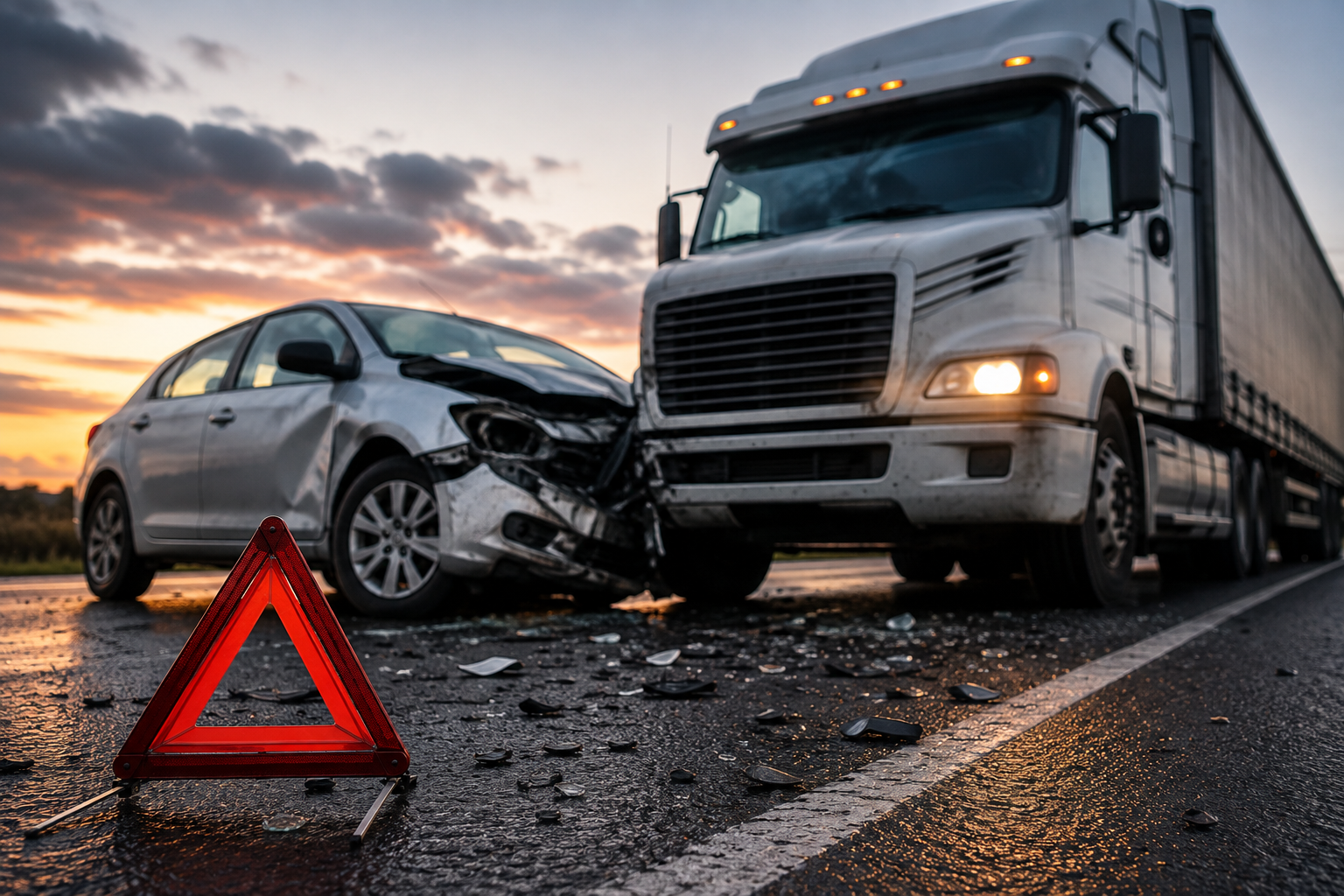
Truck accidents differ from ordinary car accidents because heavy vehicles are larger and heavier, need more distance to stop and more space to manoeuvre, and have multiple substantial blind spots. Their cargo, commercial operation and the number of parties involved in getting a load from A to B can also introduce safety and responsibility considerations that simply do not arise in a collision between two cars.
“Truck” covers a wide range of vehicles, heavy rigid trucks, prime movers hauling semi-trailers, B-double combinations and road trains — and the differences between them and a passenger car are not just a matter of degree. The physics are different, the visibility is different, and the chain of people responsible for the vehicle being on the road safely is longer.
How Are Truck Accidents Different From Car Accidents?
Size and weight
A fully loaded articulated truck can weigh many times what a family car weighs. In a collision, that difference in mass means the energy is not shared evenly. The occupants of the lighter vehicle absorb proportionally more of it, regardless of how well that vehicle performs in a standard crash test — those tests are conducted against barriers and similar-sized vehicles, not against a loaded semi-trailer.
Longer stopping distances
The NHVR is direct about this: heavy vehicles cannot stop suddenly and require longer braking distances. Weight, speed, road surface, gradient and load all extend the distance needed. This is why cutting in front of a truck and then braking is one of the more dangerous things a car driver can do — the truck behind you may not have the room to respond, however alert its driver is.
Larger turning circles and manoeuvring space
Articulated vehicles need to swing wide to complete a turn, and the trailer follows a tighter path than the cab — the reason a truck turning left may first move right. Trailer swing, off-tracking and the sheer space required at intersections all create situations where a car positioned normally relative to another car is positioned dangerously relative to a truck.
Multiple large blind spots
Heavy vehicles have significant blind spots along both sides, directly behind, and immediately in front of the cab. The NHVR consistently reminds motorists that if you cannot see the truck driver’s mirrors, the driver cannot see you. These areas are large enough to conceal an entire car, and they are particularly hazardous for motorcyclists, cyclists and pedestrians.
Why Can Truck Crashes Cause Serious Injuries?
Severity depends on the type of collision, speed, the vehicles involved, occupant position and how safety systems perform — not simply on whether a truck was involved. But the national picture does show where the harm falls.
BITRE’s heavy vehicle road trauma data for 2021 recorded 163 people killed in crashes involving heavy trucks, representing 15.4 per cent of total road deaths that year. Of those killed, approximately 50 per cent were occupants of a light vehicle, around 25 per cent were occupants of the heavy truck, and around 25 per cent were other road users such as pedestrians, motorcyclists or cyclists. Roughly 80 per cent of fatalities in fatal heavy truck crashes occurred in multiple vehicle crashes.
In other words, the people most often seriously harmed in a truck crash are the people in the other vehicle.
Injuries commonly involved
Head injuries including traumatic brain injury, spinal and neck injuries, back injuries, fractures, internal injuries, soft-tissue injuries such as whiplash, and psychological injuries including post-traumatic stress can all follow a heavy vehicle collision. Some present immediately; others, particularly soft-tissue and psychological injuries, may take hours or days to become apparent.
What Types of Truck Accidents Are Common?
What makes each of these distinctive is not the manoeuvre itself but how the truck’s characteristics change it.
• Rear-end collisions: The truck’s longer stopping distance means less margin when traffic ahead slows suddenly
• Side-impact and T-bone crashes: The height mismatch means impact often occurs above a car’s main side-impact protection
• Blind-spot collisions typically during lane changes, where the other vehicle was never visible to the driver
• Rollovers mean a high centre of gravity makes heavy vehicles more susceptible on curves, ramps and during evasive steering
• Jackknife incidents when the trailer swings out of line with the cab, under heavy braking or in poor traction
• Wide-turn collisions: vehicles caught in the gap created when a truck swings out before turning
• Underride-type collisions where a smaller vehicle travels under part of the truck or trailer, bypassing normal crash structures
• Cargo-related incidents: loads shifting, falling or affecting vehicle stability
• Multi-vehicle crashes: a heavy vehicle involved in a collision can affect several vehicles across multiple lanes
How Can Truck Driver Fatigue Contribute to an Accident?
Fatigue is one of the most significant safety issues in the heavy vehicle industry, and it is regulated for that reason. Drivers of fatigue-regulated heavy vehicles operate under work and rest requirements and record their hours in a work diary.
An important point that is missed: complying with work and rest hours is not the whole obligation. A driver must not operate a heavy vehicle while impaired by fatigue even if they remain within their permitted work and rest limits. Hours-based compliance and actual fitness to drive are two separate questions.
Fatigue affects reaction time, judgement of speed and distance, and attention, and can produce microsleeps lasting a few seconds — long enough at highway speed to cover a substantial distance with nobody effectively in control. Scheduling pressure, unrealistic delivery windows, and inadequate rest facilities can all contribute, which is why responsibility for fatigue is not treated as resting solely with the driver.
How Can Cargo and Loading Contribute to Truck Crashes?
Load restraint is regulated because an unrestrained or poorly restrained load is a genuine road safety hazard, not merely a commercial problem.
The NHVR’s Load Restraint Guide sets out that a restraint system must prevent the load from becoming dislodged or moving excessively, and must be capable of withstanding the forces generated during braking, cornering and acceleration. Those forces are substantial; a load that stays put in ordinary driving can move sharply under emergency braking.
• Improperly secured loads that shift or fall
• Cargo movement that changes the vehicle’s balance mid-manoeuvre
• Overloading, or uneven weight distribution that raises the centre of gravity
• Loads falling onto the roadway and creating hazards for following traffic
• Liquid or loose bulk loads that surge and destabilise the vehicle
Load movement matters beyond the load itself. A shifting load changes the vehicle’s handling and braking behaviour at precisely the moment the driver most needs it to be predictable.
Who Could Be Responsible for a Truck Accident?
In a two-car collision, the question is usually about the conduct of one or both drivers. Heavy vehicle transport works differently, because safety duties under the Heavy Vehicle National Law are shared across what is known as the Chain of Responsibility.
Under that framework, parties who influence how a heavy vehicle is operated — operators, schedulers, loading managers, loaders, packers, consignors and consignees each hold safety duties, and executives hold a due diligence duty. The premise is that a driver cannot be safe if the schedule, the load or the vehicle makes safety impossible.
Parties whose conduct may be relevant
• The truck driver: speed, distraction, fatigue, unsafe manoeuvres, failure to keep a proper lookout
• The trucking company or operator: scheduling, training, supervision, vehicle condition
• Maintenance providers: brake, tyre and mechanical servicing
• Loading parties — how the load was packed, distributed and restrained
• Manufacturers or other third parties: where a defect or component failure is involved
• Other road users: including drivers of other vehicles in the collision
Two cautions here. Nobody is automatically liable because of their role — responsibility depends on the facts, the evidence and the applicable law. And Chain of Responsibility duties are regulatory safety obligations under heavy vehicle law; they are not the same test as civil liability in a personal injury claim, even though the same conduct may be relevant to both.
Why Is Determining Fault in a Truck Accident Sometimes More Complex?
Because commercial vehicle operations generate records that private motoring does not. A car crash investigation typically works from driver accounts, witnesses, police information and the physical scene. A heavy vehicle crash may involve all of that plus:
• Driver work diary and fatigue records
• Vehicle telematics and engine control module data
• Maintenance and inspection records
• Loading and consignment documentation
• Scheduling and dispatch records
• Operator policies and training records
• Dashcam or in-cab camera footage
More evidence sources means more that can corroborate or contradict an initial account and more that may need to be requested before it is overwritten or disposed of in the ordinary course of business. It also means more parties with an interest in the outcome, which is part of why these matters can take longer to resolve than a straightforward car collision.
What Should You Do After a Truck Accident?
Prioritise immediate safety
Move out of traffic if it is safe to do so, and be alert to spilled fuel or fallen cargo. Call 000 if anyone is injured or the road is blocked or hazardous.
Seek medical attention
Get assessed even if you feel able to walk away. Adrenaline can mask pain, and soft-tissue and head injuries can take hours or days to present. Tell the doctor the injury came from a motor vehicle accident so the context is recorded.
Report the accident where required
Report to police where the circumstances require it, and obtain the report or event number if one is issued.
Record the scene and the vehicles
Photograph vehicle positions, damage to all vehicles, the road and its conditions, skid marks, debris and any spilled load. Photograph the truck’s registration, any operator name or livery, and trailer markings — these identify who was operating the vehicle, which matters more with commercial vehicles than with private cars.
Collect witness details and keep records
Take names and contact numbers rather than relying on statements being taken later. Keep medical and treatment records, receipts, and a note of how your injuries affect your work, sleep and daily activities.
What Evidence Can Help After a Truck Accident?
| Evidence | Why it can matter |
| Police report | Records the reported circumstances of the collision |
| Medical records | Documents injuries, diagnosis and treatment |
| Photos and video | Captures vehicles, road conditions and surroundings |
| Witness details | Independent accounts of what happened |
| Dashcam or CCTV | May show how the collision actually occurred |
| Vehicle and operator identification | Identifies the vehicles, operator and relevant insurers |
| Employment and income records | Documents financial impact and time off work |
| Treatment and rehabilitation records | Shows ongoing care and recovery |
| Truck and operator records | Work diary, telematics, maintenance and loading documents |
No single document establishes liability on its own. Evidence supports an assessment of what happened; it does not decide it.
How Does CTP Insurance Apply After a Truck Accident?
Queensland’s compulsory third party scheme covers people injured in motor vehicle accidents caused wholly or partly by another driver, giving access to insurer-funded medical treatment and rehabilitation and compensation for losses. A claim is made against the CTP insurer of the vehicle that may have caused the accident — including where that vehicle is a truck.
All claims are assessed individually, and what a person may receive depends on the type and severity of the injury and their personal circumstances. If you were partly responsible, a claim may still be available but compensation may be reduced.
The process after a heavy vehicle collision shares many features with car accident compensation generally, the same scheme, the same claim form, the same time limits. What tends to differ is the evidence involved and the number of parties whose conduct may be relevant to how the accident happened.
Time limits are strict. A Notice of Accident Claim Form generally must be lodged within nine months of the accident, or within nine months of when symptoms first appeared if injuries were not immediately apparent — or within one month of first meeting with a lawyer engaged to handle the claim, whichever comes first. Shorter timeframes apply where the at-fault vehicle cannot be identified.
When Should You Get Legal Advice After a Truck Accident?
You are not required to have a lawyer to make a CTP claim in Queensland, and many straightforward claims proceed without one. Advice is more likely to be worthwhile where:
• Injuries are serious, permanent or slow to resolve
• Responsibility is disputed, or you have been blamed for the collision
• More than one party may have contributed — operator, loader, maintenance provider
• Loss of income is significant or ongoing
• The medical evidence is complex or contested
• A commercial operator and its insurer are actively investigating
• You are unsure which deadline applies to your circumstances
• A settlement has been offered and you are unsure whether it reflects the full impact
Where a truck accident involves serious injuries, disputed responsibility or complex commercial evidence, speaking with QLD truck accident lawyers may help clarify the claim process that applies and what options are available. Bear in mind the one-month rule: once you engage a lawyer, the claim form must be lodged within a month of that first meeting.
Truck Accidents vs Car Accidents: Key Differences
| Factor | Truck accident | Typical car accident |
| Vehicle mass | Usually substantially greater | Broadly comparable vehicles |
| Stopping distance | Often considerably longer | Generally shorter |
| Blind spots | Multiple large blind spots | Fewer and smaller |
| Manoeuvring | Requires significantly more space | Generally straightforward |
| Cargo | May introduce additional risks | Usually limited |
| Fatigue regulation | Work and rest hours regulated | Not regulated |
| Parties involved | Driver, operator, loader, maintenance and others | Often just the drivers |
| Evidence | May include commercial and operator records | Usually more contained |
Frequently Asked Questions
Why are truck accidents different from car accidents?
Heavy vehicles are much heavier, need longer distances to stop, require more space to manoeuvre and have multiple large blind spots. Cargo, regulated fatigue requirements and the number of parties involved in the vehicle’s operation add further differences.
Why do trucks take longer to stop?
Greater mass takes more energy to bring to a halt. Speed, road surface, gradient and load all extend the distance further. The NHVR is explicit that heavy vehicles cannot stop suddenly and require longer braking distances.
Why are truck blind spots so dangerous?
They are large enough to conceal an entire car, and they exist along both sides, behind and immediately in front of the cab. If you cannot see the driver’s mirrors, the driver almost certainly cannot see you.
What are the most common types of truck accidents?
Rear-end and side-impact collisions, blind-spot crashes during lane changes, rollovers, jackknife incidents, wide-turn collisions, underride-type collisions and cargo-related incidents. Around 80 per cent of fatalities in fatal heavy truck crashes occur in multiple vehicle crashes.
Can truck driver fatigue cause an accident?
Fatigue is a significant safety issue in the heavy vehicle industry. Drivers of fatigue-regulated vehicles work under regulated work and rest hours, and must not drive while impaired by fatigue even if they remain within those limits.
Can improperly loaded cargo cause a truck accident?
Yes. A load restraint system must prevent the load from dislodging or moving excessively and withstand forces generated during braking, cornering and acceleration. Shifting or falling loads can affect stability and create hazards for other road users.
Who can be responsible for a truck accident?
Depending on the facts, the driver, operator, loading parties, maintenance providers, manufacturers or other road users. Heavy vehicle law spreads safety duties across the Chain of Responsibility, but responsibility in any case depends on evidence.
What evidence is important after a truck accident?
Police information, medical records, photographs, witness details and dashcam footage, plus commercial records such as work diaries, telematics data, maintenance records and loading documentation that have no equivalent in an ordinary car crash.
Can I claim compensation after a truck accident in Queensland?
Possibly, where the accident was caused wholly or partly by another driver. Claims are assessed individually, and outcomes depend on injury severity and personal circumstances. If you were partly at fault, compensation may be reduced.
Does CTP insurance cover truck accident injuries?
Queensland CTP covers people injured in motor vehicle accidents caused wholly or partly by another driver, including where the at-fault vehicle is a truck. The claim is made against that vehicle’s CTP insurer.
What should I do immediately after a truck accident?
Get to safety, call 000 if anyone is injured, seek medical assessment even if you feel unhurt, photograph the scene and the truck’s identifying details, collect witness contacts and keep all medical and treatment records.
When should I speak to a truck accident lawyer?
You do not need one to claim. Advice is most useful where injuries are serious, responsibility is disputed, several parties may be involved, the evidence is complex, or you have received a settlement offer.
Final Takeaway
Trucks are not simply larger cars. They stop over longer distances, need more room to turn, carry blind spots that swallow whole vehicles, and operate under a regulatory framework that spreads safety duties across everyone who influences how the vehicle runs. When something goes wrong, those same differences shape what happened and what evidence exists to explain it.
If you have been involved in a heavy vehicle collision, the practical priorities are unchanged: get medical attention, document what you can while it is available, and check which timeframes apply to your circumstances before assuming you have longer than you do.
