

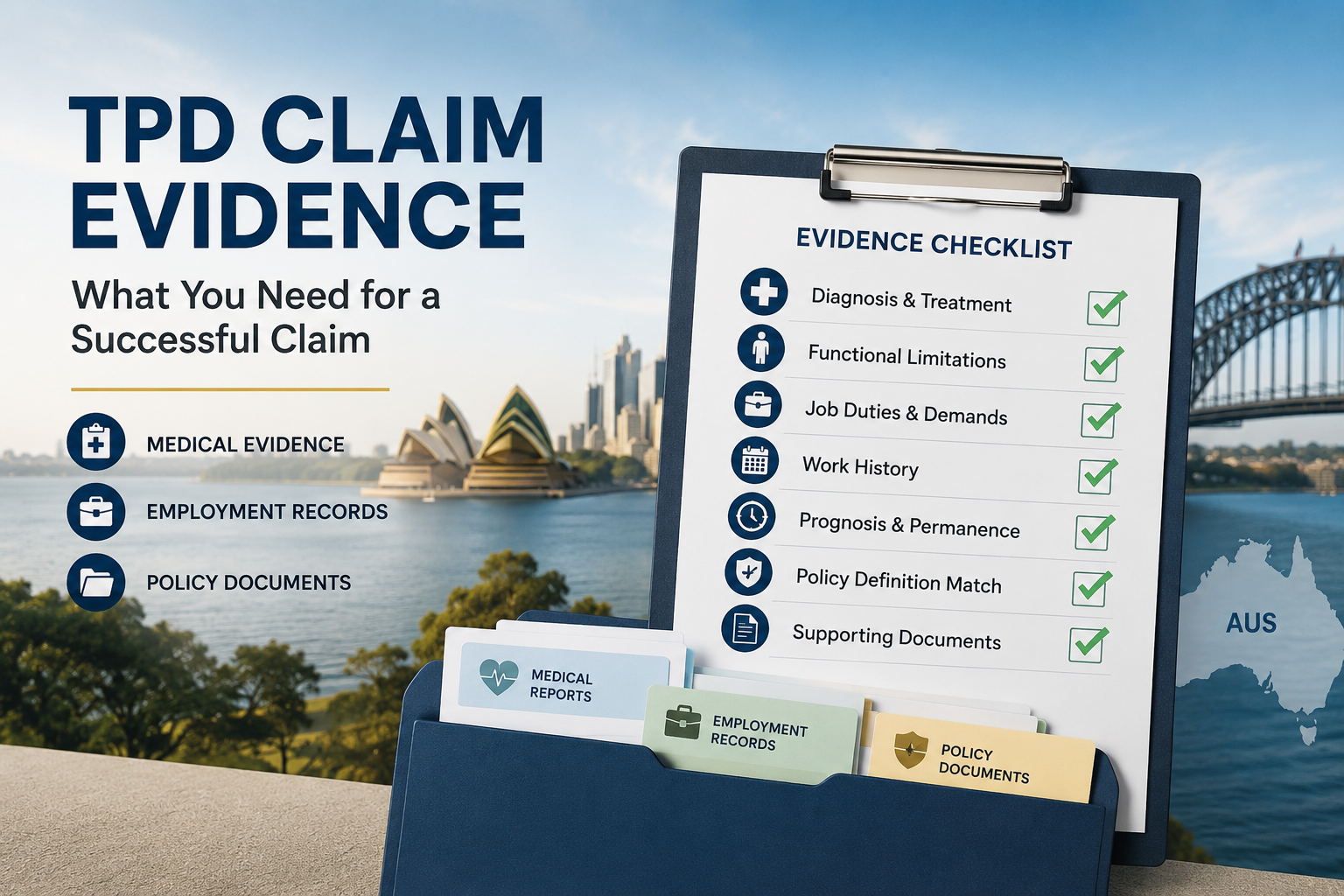
A successful TPD superannuation claim generally depends on evidence showing that you meet the specific definition of total and permanent disability set out in your policy. In practice, that usually involves medical evidence, employment records, detailed information about your actual job duties, your work history, and other documentation relevant to your circumstances.
Many people assume that a serious diagnosis is enough. It usually is not. Total and Permanent Disability (TPD) insurance held through a superannuation fund does not pay a benefit simply because someone is unwell or injured. The insurer assesses whether the evidence establishes that the claimant meets a particular contractual test — and that test varies from policy to policy.
That is why the strongest claims are the ones where the evidence has been built to answer the policy’s question, not just to describe a medical condition. This article explains what TPD evidence needs to prove, what medical and employment documents are typically relevant, how the different policy definitions change what matters, and where claims most often run into evidence problems.
Understanding how insurers weigh evidence is one of the most practical things you can do before lodging. It is also the reason detailed guides to TPD superannuation claims spend so much time on documentation rather than on diagnosis alone.
What Does TPD Evidence Need to Prove?
TPD evidence generally needs to establish three connected things. Weakness in any one of them can undermine the whole claim, even when the other two are well documented.
1. Your medical condition or injury
This is the foundation: what the condition is, how it developed, and what has been done about it. Relevant material usually covers:
• Diagnosis and any differential or secondary diagnoses
• Symptoms and their severity
• Treatment history, including medication, surgery and therapy
• Functional restrictions arising from the condition
• Prognosis and expected recovery
• Whether the restrictions are considered permanent
2. How your condition affects your ability to work
This is where most claims are won or lost. Medical evidence that stops at the diagnosis leaves the insurer to draw its own conclusions about work capacity. Stronger evidence follows a clear chain:
- Diagnosis
- Functional limitations
- The actual requirements of the job
- Inability to perform those requirements
- Permanence
Two people with the same diagnosis can have very different claims, because the same restriction may be disabling in one occupation and manageable in another. The evidence has to bridge that gap explicitly.
3. That you satisfy the policy definition
Ultimately, the policy wording decides what must be demonstrated. An “any occupation” definition, for example, may require the insurer to consider whether you could work in some other occupation for which you are reasonably suited by education, training or experience. Evidence that only addresses your previous role may not answer that question. ASIC’s Moneysmart guidance makes the same point in consumer terms: TPD definitions differ between policies, and the Product Disclosure Statement is where you find the one that applies to you.
What Medical Evidence Is Usually Needed for a TPD Claim?
Medical reports and specialist assessments
Insurers generally look for a combination of treating-practitioner evidence and specialist opinion. Commonly relevant material includes GP reports and clinical notes, treating specialist reports, consultant opinions, diagnostic reports such as imaging and pathology where relevant, hospital and treatment records, and rehabilitation reports.
Moneysmart notes that insurers may ask for medical reports and test results, may seek your permission to obtain medical records directly, and may arrange an independent medical examination. An independent examination is a normal part of many assessments rather than a sign that something has gone wrong.
Evidence of functional limitations
Functional evidence describes what you can and cannot do, in practical terms. Depending on the condition, that may include capacity for sitting, standing, walking, bending and lifting; manual dexterity and repetitive tasks; concentration, memory and problem-solving; communication and interaction with others; fatigue and pain levels across a working day; psychological functioning; and the ability to sustain work reliably over time rather than in short bursts.
That last point matters more than people expect. Being able to perform a task once is not the same as being able to perform it consistently across a working week, and evidence that addresses sustainability is often more persuasive than evidence that addresses maximum capability.
Prognosis and permanence
Because TPD is about permanent incapacity, insurers look for evidence addressing whether recovery is expected, what treatment options remain, whether further treatment is likely to restore work capacity, whether the restrictions are expected to continue indefinitely, and whether the condition is permanent in the sense used in the policy wording.
No diagnosis automatically qualifies. Two claims involving the same condition can be assessed very differently depending on treatment response, prognosis and the applicable definition.
Why Your Job Duties Matter as Much as Your Diagnosis
There is a significant difference between “I have an injury” and “my injury prevents me from performing the essential duties of my occupation.” Only the second statement engages the policy test, and only the second can be tested against evidence.
Evidence about your actual occupation
Job titles are rarely descriptive enough on their own. A “supervisor” might spend the day at a desk or on scaffolding. Useful evidence covers the daily responsibilities you actually performed, physical requirements such as lifting weights and time on your feet, hours worked each week, the work environment, cognitive and decision-making demands, travel requirements, safety responsibilities, and any professional registration or licensing requirements attached to the role.
Moneysmart specifically recommends providing information about work duties, physical requirements and weekly hours when making an insurance claim, which reflects how central this material is to the assessment.
Employment records that may support the claim
Depending on your situation, position descriptions, employment contracts, employer statements, payslips, tax records, leave records, performance records, evidence of workplace adjustments, return-to-work attempts and workers compensation records may all be relevant. Not every claimant needs every document — the point is to cover the ground the insurer actually has to assess, not to assemble the largest possible file.
What Employment Evidence Can Strengthen a TPD Superannuation Claim?
The table below sets out common employment documents and what each one can help demonstrate.
| Evidence | What it can help demonstrate |
| Job description | Your actual duties and responsibilities |
| Employer statement | The practical impact of the condition on your ability to perform the role |
| Payslips | Employment status and earnings history |
| Tax returns | Work and income history, particularly for self-employed claimants |
| Leave records | Time away from work and patterns of absence |
| Return-to-work records | Attempts to return and the limitations encountered |
| Workplace adjustments | Functional limitations recognised in the workplace |
| Vocational assessments | Capacity, or lack of capacity, for alternative work |
Moneysmart lists payslips, tax returns and financial statements for self-employed claimants among the information that may be requested during a claim.
What Other Documents May Be Relevant to a TPD Claim?
Insurance and superannuation documents
These establish that cover existed and identify the test that applies: superannuation fund statements, the insurance certificate or schedule, the Product Disclosure Statement, the policy wording, details of cover dates and amounts, and correspondence with the fund or insurer.
Treatment and rehabilitation records
Rehabilitation plans, physiotherapy and occupational therapy records, psychology or psychiatry records where relevant, and specialist treatment history all help show what has been tried and what the response has been. This material speaks directly to prognosis.
Chronology and consistency
Insurers read medical, employment and insurance records together. Where dates, described duties or reported symptoms differ between records, the inconsistency itself can become an issue — even where there is an innocent explanation. Reviewing the chronology across all sources before lodging is worth the effort.
How to Match Your Evidence to the TPD Policy Definition
This is the step most often skipped. The same file of documents can be strong under one definition and thin under another.
| Definition | General focus of the assessment | Evidence emphasis |
| Own occupation | Whether you can return to your own occupation | Detailed duties of your specific role |
| Any occupation | Whether you can work in another occupation you are reasonably suited to by education, training or experience | Transferable skills, retraining capacity, vocational evidence |
| Activities of daily living | Whether you can perform fundamental daily activities specified in the policy | Functional and care evidence against the listed activities |
Own occupation TPD
The focus is generally on your own occupation, subject to the exact wording. Evidence about the specific demands of your role carries the most weight.
Any occupation TPD
This definition is common in cover held through superannuation. Because the assessment may consider alternative occupations, evidence about your education, training, work experience and realistic retraining prospects becomes important alongside the medical material.
Activities of daily living
Some policies use an ADL-based test tied to fundamental daily activities. The threshold is generally higher, and the evidence needs to address the listed activities directly rather than work capacity in general.
Common Evidence Problems That Can Weaken a TPD Claim
None of the issues below automatically causes a claim to fail, but each is a recurring source of delay and dispute:
• Medical evidence describes the condition but never addresses work capacity.
• Job duties are described in general terms that do not reveal the real demands of the role.
• Different records contain inconsistent dates, duties or symptom histories.
• Nothing in the file squarely addresses permanence or prognosis.
• The claim is prepared against the wrong policy definition.
• Records from an earlier treating practitioner or previous employer are missing.
• The evidence focuses on diagnosis rather than functional limitation.
ASIC’s review of TPD insurance claims, published as Report 633, raised concerns about claim outcomes and restrictive disability definitions in this part of the market. That context is a useful reminder that the definition applied to a claim is not a technicality — it shapes everything about what the evidence has to establish.
How to Organise Evidence Before Lodging a TPD Claim
Step 1 — Find the applicable policy
Identify the superannuation fund or funds, the insurer, the policy wording, the dates cover was in force, and the TPD definition that applies. People with multiple super accounts sometimes have more than one policy, and the terms may not be the same.
Step 2 — Create a medical timeline
Record onset or injury, diagnosis, treatment, specialist appointments, work restrictions imposed, and any changes in capacity over time. A clear timeline makes gaps visible and helps practitioners write more useful reports.
Step 3 — Document your employment history
Set out your role, duties, hours, any changes in duties, leave taken and attempts to return to work. Where duties changed after the injury, note what was removed or modified and why.
Step 4 — Identify evidence gaps
• Does the medical evidence address functional capacity, not just diagnosis?
• Does the employment evidence explain what the job actually required?
• Does anything address permanence and prognosis?
• Does the evidence answer the specific policy definition that applies?
Step 5 — Keep copies of correspondence
Keep everything exchanged with the super fund, insurer, treating doctors and claims administrators, including dates of phone calls. If the claim is later disputed, this record often matters.
Can a TPD Claim Be Successful Without One Specific Piece of Evidence?
There is no single document that guarantees a successful TPD claim. What is required depends on the policy wording and the claimant’s circumstances, and a claim is generally assessed on the overall body of evidence relevant to the applicable TPD definition.
A missing document is not necessarily fatal, particularly where the same point is established another way. Equally, a thick file is not persuasive on its own if it never addresses the policy test.
What Happens If a TPD Claim Is Declined?
A declined claim is not always the end of the matter. The usual sequence is:
• Ask for written reasons, including which definition was applied and which evidence was relied on.
• Review the policy definition against the reasons given.
• Identify gaps, disputed medical opinions or factual errors in the assessment.
• Use the insurer’s or super fund’s internal complaints process.
• If it remains unresolved, take the complaint to external dispute resolution.
Moneysmart advises that if you are unhappy with how an insurance claim has been handled or decided, you can complain to the insurer or super fund and, if the complaint is not resolved, contact the Australian Financial Complaints Authority (AFCA) for free, independent dispute resolution. Time limits apply to some complaints, so it is worth checking them early rather than late.
When Should You Get Help With a TPD Superannuation Claim?
Plenty of claims are lodged and paid without assistance. Some situations are harder to navigate alone, including:
• A complex or long medical history involving several conditions
• Multiple superannuation accounts or overlapping policies
• Policy wording that is unclear or unusually restrictive
• A genuine dispute about your remaining work capacity
• An insurer requesting extensive further evidence or repeated examinations
• A claim that has already been declined
• Disagreement about whether an alternative occupation is realistically open to you
Where a claim involves contested medical evidence, disputed work capacity or a question of policy interpretation, speaking with Experienced TPD insurance lawyers can help you understand what the definition actually requires, what evidence is missing, and what options remain if the insurer has already made a decision.
Frequently Asked Questions About TPD Claim Evidence
What evidence do I need for a TPD superannuation claim?
Generally, medical evidence, employment evidence and your policy documents. The medical material should address diagnosis, functional limitations and permanence, while the employment material should show what your job actually required. The exact requirements depend on the definition in your policy.
Do I need a specialist medical report for a TPD claim?
Not always, but specialist evidence is often persuasive where the condition is complex or the prognosis is contested. GP evidence is still important because treating practitioners usually have the longest view of your functional capacity over time.
Does a diagnosis automatically qualify me for TPD?
No. A diagnosis alone does not establish that you meet the policy definition. The evidence needs to connect the condition to functional limitations, to the requirements of the relevant occupation, and to permanence.
Does my employer need to provide evidence?
Often an employer statement or position description is requested, because it helps establish your actual duties, hours and any workplace adjustments. Where an employer is unavailable, other records such as payslips, contracts or tax returns may assist.
What employment documents can support a TPD claim?
Position descriptions, employment contracts, employer statements, payslips, tax returns, leave records, return-to-work records and vocational assessments are all commonly relevant, depending on your circumstances.
Can I claim TPD if I have tried returning to work?
Attempting to return to work does not automatically prevent a claim. What matters is what the attempt showed about your capacity. Documenting why the return was unsuccessful can strengthen rather than weaken the evidence.
What happens if the insurer asks for more medical evidence?
This is common and does not mean the claim is being refused. The insurer may request further reports, access to medical records, or an independent medical examination before making a decision.
What happens if my TPD claim is rejected?
You can ask for written reasons, review the decision against the policy definition, and lodge a complaint through the insurer’s or super fund’s internal process. If it is not resolved, AFCA provides free external dispute resolution.
How long does a TPD claim take?
Timeframes vary considerably depending on the complexity of the medical evidence, how quickly reports are obtained, and whether further assessments are required. Claims involving disputed capacity or missing records typically take longer.
Final TPD Evidence Checklist Before You Submit
• Relevant TPD policy or policies identified
• PDS and policy wording reviewed
• Cover dates confirmed
• GP evidence collected
• Specialist evidence collected where relevant
• Diagnosis and treatment history documented
• Functional limitations clearly explained
• Job duties documented in practical detail
• Employment history documented
• Work capacity addressed, including sustainability
• Prognosis and permanence addressed
• Relevant financial and employment records collected
• Evidence checked for internal consistency
• Claim form and supporting documents reviewed before lodging
Final Thoughts
TPD claims are decided on evidence measured against a contractual definition, not on the seriousness of a condition in the abstract. The most useful thing a claimant can do is work backwards from the policy wording: identify the test that applies, then check whether the medical and employment evidence actually answers it. Where it does not, the gap is usually fixable before lodgement and much harder to fix afterwards.
