

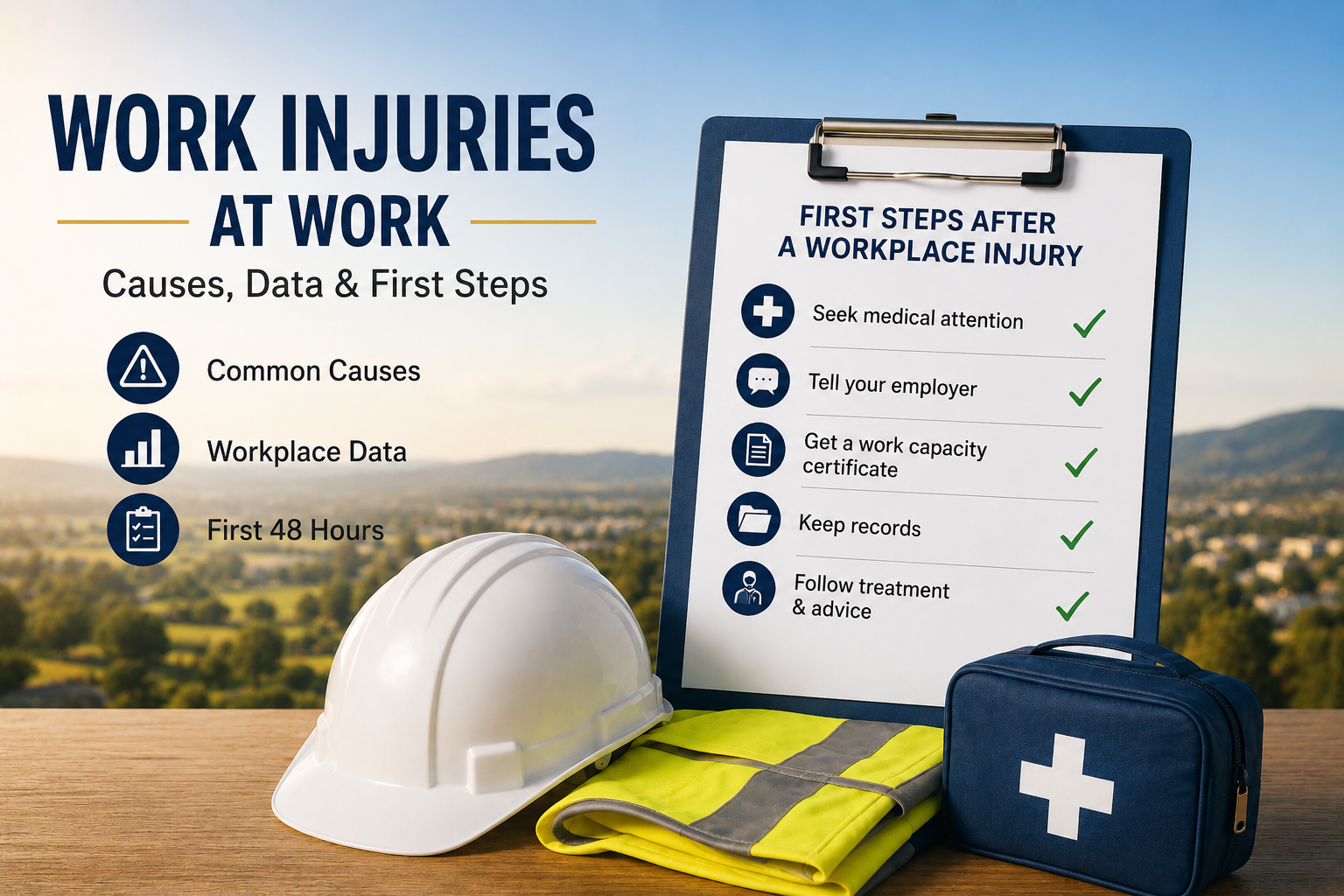
The decisions a worker makes in the first hours and days after a workplace injury can affect how the injury is documented, what medical evidence exists, and how a WorkCover claim is later assessed. Seeking medical attention promptly, telling your employer, obtaining a work capacity certificate and giving accurate, complete information all help create a clear record of what happened and how it has affected your work capacity.
None of that guarantees an accepted claim. What it does is make sure the insurer has the information it needs to assess your circumstances properly, rather than deciding on an incomplete file.
That distinction matters in Queensland, because a workers’ compensation claim is decided against specific criteria rather than on general fairness. WorkSafe Queensland sets out the questions an insurer must work through: whether the claim was made in the right timeframe, whether the person was working for the employer when injured, whether they meet the definition of a worker, whether a work-related incident caused the injury, and whether their job was a significant contributing factor to it.
What Should You Do Immediately After a Workplace Injury?
Seek medical attention
WorkSafe Queensland treats seeking medical assistance as the first step after a work-related injury or illness, with hospital or emergency care where the injury is serious. Beyond the obvious health reasons, the first consultation creates the earliest independent record of your condition.
When you see the doctor, explain clearly that the injury occurred at work, describe how it happened, and mention every symptom, including those that seem minor or unrelated. Follow the recommended treatment and keep the appointments scheduled for you.
Tell your employer as soon as possible
Notifying your employer creates an incident record, allows them to respond to any ongoing hazard, helps establish when and where the incident occurred, and starts the workplace injury management process. Where possible, put the notification in writing or follow up a verbal report with an email, so there is a dated record.
A delay in telling your employer does not automatically end a claim. It can, however, mean the insurer has less contemporaneous information to work with, which sometimes leads to further questions later.
Obtain a work capacity certificate
In Queensland, the work capacity certificate is the central medical document in a claim. It records your injury and diagnosis, how and when the injury occurred, the treatment required, your capacity for work, any restrictions, and expected treatment or rehabilitation timeframes.
WorkSafe Queensland describes it as information the insurer uses when deciding a claim, and as the basis for planning suitable duties and return-to-work arrangements. If you are treated at a hospital, ask for a copy of the certificate for your own records as well as for the insurer.
Why the First Medical Assessment Can Be Important
“See a doctor” is standard advice. What is less often explained is that the quality of what gets written down at that first appointment can shape the whole claim.
Clearly explain how the injury happened
Try to cover the date, the time, the location, the task you were performing, the mechanism of injury, and the symptoms you noticed immediately. If the problem developed gradually rather than in a single incident, say so — gradual-onset injuries are assessed differently, and describing a slow build-up as a sudden event creates an inconsistency that may surface later.
Make sure all relevant injuries are documented
This is one of the most common practical problems. A worker with a badly injured shoulder may not mention the back pain that started at the same time, because the shoulder is what hurts most that week. Months later, the back becomes the bigger problem — and it is not on the certificate.
WorkSafe Queensland specifically directs workers to make sure all the injuries they want assessed are included on the work capacity certificate. If something has been left off, raise it with your treating doctor rather than assuming it can be added informally later.
Keep Evidence of What Happened
Write down the circumstances while they are fresh
Memory fades quickly, and claims can take months. A short written note made on the day is worth more than a careful reconstruction six months on. Record the date and time, the workplace location, the task you were doing, any equipment involved, what actually happened, the symptoms you felt, and who was nearby.
Identify witnesses
When an insurer assesses a claim it may gather information from the worker, the employer, treating doctors, witnesses to the incident and, in some cases, an independent medical examiner. Having the names of people who saw the incident — or who saw you immediately afterwards — can help if the circumstances are later queried.
Preserve relevant workplace records
Depending on the situation, incident reports, rosters, task or job records, relevant emails and messages, photographs where it is appropriate to take them, and safety records may all be useful. Keep copies of anything you are properly entitled to access. Do not attempt to obtain confidential company documents you have no right to, that creates a separate problem without helping the claim.
Why Your Work Capacity Certificate Matters
What the certificate tells the insurer
The certificate carries the chain the insurer needs to follow:
- Injury
- Diagnosis
- Treatment
- Capacity
- Restrictions
- Suitable duties
How restrictions affect return-to-work planning
Restrictions are not only about whether you can work at all. They may cover reduced hours, modified duties, limits on lifting or standing, temporary incapacity, or changes to your work environment. Clear restrictions give your employer something concrete to plan around, which usually produces a better return-to-work outcome than a vague certificate.
Keep certificates current
An expired certificate can interrupt payments and stall a claim. If your condition changes in either direction, tell your treating doctor so the certificate reflects your actual capacity rather than the position several weeks ago.
Be Accurate and Consistent When Describing Your Injury
Insurers read your account across several documents at once: what you told the doctor, what the employer recorded, what appears on the work capacity certificate, what you wrote on the claim form, and anything you say later in the claim. Where those accounts differ, the difference itself can become an issue — even where there is a perfectly innocent explanation.
Don’t exaggerate symptoms
Overstating your limitations rarely helps and can undermine your credibility on the points that genuinely matter.
Don’t minimise symptoms either
Playing down pain or difficulty is far more common, particularly among workers who do not want to seem unreliable. If the record understates your condition, the assessment will too.
Don’t guess when you don’t remember
If you are unsure of a time or a sequence, say you are unsure. An honest “I can’t recall exactly” is more robust than a guess that later turns out to be wrong.
Correct genuine errors when you spot them
If a record contains a mistake, raise it promptly and in writing rather than leaving it to be discovered later.
Accuracy is more valuable than making an injury sound either more serious or less serious than it is. These steps don’t guarantee a successful WorkCover claim, but they do help ensure your circumstances are properly documented and assessed on the evidence rather than on gaps in it.
What Information WorkCover May Consider
It helps to understand what the insurer is actually deciding. WorkSafe Queensland sets out the criteria drawn from the Workers’ Compensation and Rehabilitation Act 2003:
| What the insurer considers | Why it matters to your evidence |
| Whether the claim was made in the right timeframe | When you first saw a doctor about the injury is a key date |
| Whether you were working for the employer when injured | Employment records, rosters and timesheets |
| Whether you are considered a “worker” | Employment status, contracts and payment arrangements |
| Whether a work-related incident caused the injury | Incident description, witnesses, workplace records |
| Whether your job was a significant contributing factor | Medical opinion connecting the work to the injury |
That last criterion: whether employment was a significant contributing factor, meaning a large part of the cause, is where many disputed claims turn. It is also why medical evidence that simply names a diagnosis is less useful than evidence that explains the connection to your work.
Not every claim is assessed identically. Different considerations can apply to psychological injuries, industrial deafness, injuries while travelling to or from work, aggravations of pre-existing conditions, and diseases that develop over long periods.
Don’t Delay Making Your WorkCover Claim
There is usually a time limit for lodging a claim in Queensland: generally within six months of the date you were first seen by a doctor about the injury or illness, unless the insurer accepts that you have a reasonable excuse for the delay.
Because statutory time limits and the exceptions to them can be legally significant, treat that as a general description rather than advice about your own situation, and check the current Queensland government guidance or get advice if your circumstances are unusual. Gradual-onset conditions, latent-onset diseases and psychological injuries can all raise questions about when the clock started.
To lodge, you generally need an application for compensation together with your work capacity certificate listing all relevant injuries. Claims can be lodged online, by phone or on a form, and an employer can start the process on a worker’s behalf with their consent.
What Happens After You Lodge a WorkCover Claim?
The insurer — WorkCover Queensland or a self-insurer, depending on your employer gathers what it needs to decide. In practice, that usually involves:
• Contact with you within a few business days to confirm details of the injury
• Contact with your employer about your employment, wages and the incident
• Requests for medical information from your treating practitioners
• Information from any witnesses to the incident
• In some cases, an independent medical examination
An independent medical examination is a normal part of some assessments. It is not, by itself, an indication that the insurer intends to reject the claim.
How Long Does a WorkCover Claim Decision Take?
Queensland insurers aim to decide workers’ compensation claims within 20 business days or less, as outlined by legislation. If an insurer cannot decide within that period, it must contact the worker and give the reason for the delay in writing.
Delays usually trace back to missing information rather than to the merits of the claim. Common causes include:
• Employer details that have not been provided
• A missing or out-of-date work capacity certificate
• Complex medical evidence that takes time to obtain
• Additional investigation where the circumstances are unclear
If you are unhappy with the reasons given for a delay, you can ask the Workers’ Compensation Regulator to review those reasons.
Continue Following Your Treatment and Return-to-Work Plan
Once a claim is lodged or accepted, the focus shifts to recovery. What you do here affects both your health and the ongoing claim.
• Attend your medical and rehabilitation appointments
• Follow the treatment your doctor recommends, and say so if it is not working
• Tell your treating doctor and the insurer when your condition changes
• Participate in suitable duties where your doctor agrees they are appropriate
Returning to safe work is part of recovery, not a sign that the injury has resolved. Your employer may be able to adjust duties, hours, days or the work environment so a return happens sooner and more safely. Where a claim is accepted and you lose wages, the employer generally pays the first week’s compensation as an excess, with the insurer managing payments after that.
What About Psychological Injuries?
Work-related psychological injuries are covered by the Queensland scheme, and they are assessed against criteria that can differ from those applied to physical injuries. The practical steps are similar: seek treatment early, obtain a work capacity certificate that records the diagnosis, and document the workplace factors involved.
Early treatment matters here in a specific way. While a psychological injury claim is being assessed, a worker can usually access certain insurer-funded treatments — which may include GP mental health appointments, counselling or psychology sessions, psychiatry appointments, medication and reasonable travel costs to attend treatment. Accessing this support requires a lodged claim and a work capacity certificate confirming the diagnosis. If the claim is not accepted, funding stops, but a worker is not required to repay treatment already received.
If you or someone you know is in crisis, Lifeline is available on 13 11 14, and 000 if life is in immediate danger.
Common Mistakes to Avoid After a Workplace Injury
• Waiting too long to see a doctor, which leaves a gap in the medical record
• Not telling the employer, or telling them verbally with no record
• Leaving relevant injuries off the work capacity certificate
• Letting a certificate lapse during an ongoing claim
• Giving incomplete information on the claim form
• Missing medical or rehabilitation appointments without explanation
• Assuming that because an injury happened at work, the claim must be accepted
• Ignoring correspondence from the insurer, particularly requests for information
• Describing a gradual-onset injury as a single incident because it seems simpler
What If Your WorkCover Claim Is Rejected?
A rejection is not necessarily the end of the matter. Queensland has a structured review and appeal pathway.
Understand the decision and ask for reasons
If a claim is not accepted, the insurer will tell you why and confirm it in writing. Where written reasons have not been provided with the decision, you can ask the insurer for a reasons for decision document — generally within 20 business days of being advised of the decision.
Check whether the decision is reviewable
Not every insurer decision can be reviewed. Section 540 of the Workers’ Compensation and Rehabilitation Act 2003 lists the reviewable decisions, which include a decision to allow or reject an application for compensation.
Lodge an application for review
A worker, claimant or employer can lodge an application for review with the Office of Industrial Relations within three months of receiving the insurer’s written decision. The review is free, is not a court process, and is conducted by a Review Officer who examines the documentation already on the claim file.
An important practical point: the Review Officer does not re-investigate or gather further statements. It is generally recommended that applicants use the three months to obtain any additional supporting evidence before lodging, because the opportunity to add material narrows afterwards.
Appeal rights after a review
If you remain dissatisfied after the review decision, an appeal may be available to the Queensland Industrial Relations Commission. Time limits apply at this stage too, so check the current guidance promptly rather than at the end of the period.
When Should You Consider Getting Legal Help?
If you have been injured at work, understanding your rights and the evidence relevant to your particular circumstances can help you make informed decisions about what to do next. Many straightforward claims are lodged, accepted, and resolved without any legal involvement at all.
Some situations are harder to navigate alone:
• The claim has been rejected, or a review deadline is approaching
• Liability or the connection between the work and the injury is disputed
• The injury is medically complex, or several injuries interact
• A psychological injury is involved, particularly where workplace conduct is contested
• Medical evidence is contested between practitioners
• A permanent impairment assessment or a Notice of Assessment is involved
• A potential common law claim arises
• You simply do not understand what the insurer is asking for or why
It is also worth keeping the two pathways separate in your mind. A statutory workers’ compensation claim is a no-fault scheme. A common law damages claim is a separate process with a different legal test, brought where an employer’s negligence caused the injury, and it interacts with the statutory claim in ways that are worth getting advice about before making decisions.
Free, independent support is also available. The Workers’ Compensation Information and Advisory Service for Workers can be reached on 1800 102 166.
Frequently Asked Questions
What should I do immediately after being injured at work?
Seek medical attention, tell your employer as soon as you can, obtain a work capacity certificate from your doctor, and write down what happened while it is fresh. For serious injuries, go to hospital or call emergency services first and deal with the paperwork afterwards.
Do I need to see a doctor before making a WorkCover claim?
In practice, yes. A work capacity certificate from a doctor is needed to lodge a claim, and the date you were first seen by a doctor is also relevant to the lodgement timeframe. Seeing a doctor early creates the medical record the insurer will rely on.
What is a work capacity certificate?
It is the medical certificate used in Queensland workers’ compensation claims. It records your injury and diagnosis, how and when it occurred, treatment required, your capacity for work and any restrictions. Insurers use it to decide claims, and employers use it to plan suitable duties.
What does WorkCover consider when assessing a claim?
Whether the claim was made in time, whether you were working for the employer when injured, whether you meet the definition of a worker, whether a work-related incident caused the injury, and whether your employment was a significant contributing factor to it.
How long do I have to make a WorkCover claim in Queensland?
Generally, within six months of the date you were first seen by a doctor about the injury or illness, unless the insurer accepts a reasonable excuse for a later claim. Because exceptions can be legally significant, check current guidance or get advice if you are outside that period.
How long does WorkCover take to decide a claim?
Insurers aim to decide within 20 business days or less. If a decision cannot be made in that time, the insurer must contact you and explain the delay in writing. Complex medical evidence or missing employer information are the usual causes of delay.
Can I make a WorkCover claim if I have returned to work?
Returning to work does not prevent a claim. Many workers continue working on modified duties while recovering. What matters is whether the claim criteria are met and whether it is lodged within the applicable timeframe.
What happens if WorkCover asks for more information?
Respond promptly and keep a copy of what you send. Requests for further medical information, employer details or an independent medical examination are a normal part of assessment, and delays in responding are a common reason claims take longer.
What happens if my WorkCover claim is rejected?
The insurer must tell you why in writing. You can request a reasons for decision document within 20 business days, and lodge an application for review with the Office of Industrial Relations within three months of receiving the written decision. The review is free.
Can psychological injuries be covered by workers’ compensation?
Yes. Work-related psychological injuries are covered, though different criteria can apply. Certain treatments may be funded by the insurer while the claim is assessed, provided a claim has been lodged, and a work capacity certificate confirms the diagnosis.
Workplace Injury Action Checklist
Immediately after the injury
• Seek appropriate medical treatment
• Notify your employer, in writing where possible
• Record what happened while it is fresh
• Identify anyone who witnessed the incident
When making the claim
• Obtain a work capacity certificate
• Check that every relevant injury is listed on it
• Provide accurate employment information
• Lodge within the applicable timeframe
During the claim
• Attend medical and rehabilitation appointments
• Keep certificates current
• Follow the recommended treatment
• Respond promptly to insurer requests
• Keep copies of all correspondence
If there is a dispute
• Read the decision carefully and note the date you received it
• Request written reasons if they were not provided
• Check whether the decision is reviewable
• Gather supporting evidence before lodging a review
• Consider getting advice, particularly where deadlines are close
Final Thoughts
A workplace injury is decided on a record built by other people doctors, employers, insurers from information that largely comes from you. The workers who fare best in the Queensland scheme are usually not the ones with the most serious injuries, but the ones whose circumstances were documented clearly and consistently from the beginning. Seek treatment, report the injury, check the certificate, keep your own notes, and respond to what the insurer asks for. If the claim becomes disputed, that record is what you will be working from.
